Private-Label Commercial Laundry Detergents: How Chemical Brands Build Differentiated Lines
Industrial laundry customers are asking for more than a basic detergent under a private label. They want reliable stain removal across mixed soils, performance at lower wash temperatures, shorter rewash loops, fabric brightness retention, and products that fit existing dosing systems.
For an industrial laundry chemical supplier, enzyme selection is one of the clearest ways to create that differentiation. The right enzyme package can help a private-label line move beyond price-based competition and into measurable wash outcomes.
SoilVector supports chemical manufacturers building commercial laundry detergents, boosters, prespotters, and specialty additives with enzyme solutions selected for substrate fit, wash conditions, formulation compatibility, and scale-up confidence.
Looking for an enzyme supplier for industrial laundry chemicals? Use the on-site request a quote form to share your product format, target soils, and wash conditions.
Why private-label laundry lines need formulation-level differentiation
Private-label commercial laundry products often compete in a crowded space: hospitality, healthcare, food service, uniform rental, institutional laundry, and on-premise laundry operators all need performance, but their soil loads and process constraints differ.
A useful private-label line should answer specific buyer needs:
- Protein soil removal from food, blood, sweat, dairy, and body soils
- Starch and carbohydrate soil breakdown from sauces, dressings, and processed foods
- Fat and oil soil release from kitchens, uniforms, table linens, and healthcare textiles
- Cellulosic fabric care support for brightness, smoothness, and reduced greying tendency
- Low-temperature wash support where energy savings or textile protection matter
- Consistency in alkaline, surfactant-rich, builder-containing detergent systems
- Compatibility with liquids, powders, concentrates, boosters, and multi-part wash programs
The commercial value is simple: a better enzyme strategy helps your brand position each SKU around a clear use case instead of selling a generic detergent with a private label attached.
The role of enzyme class selection in commercial laundry detergents
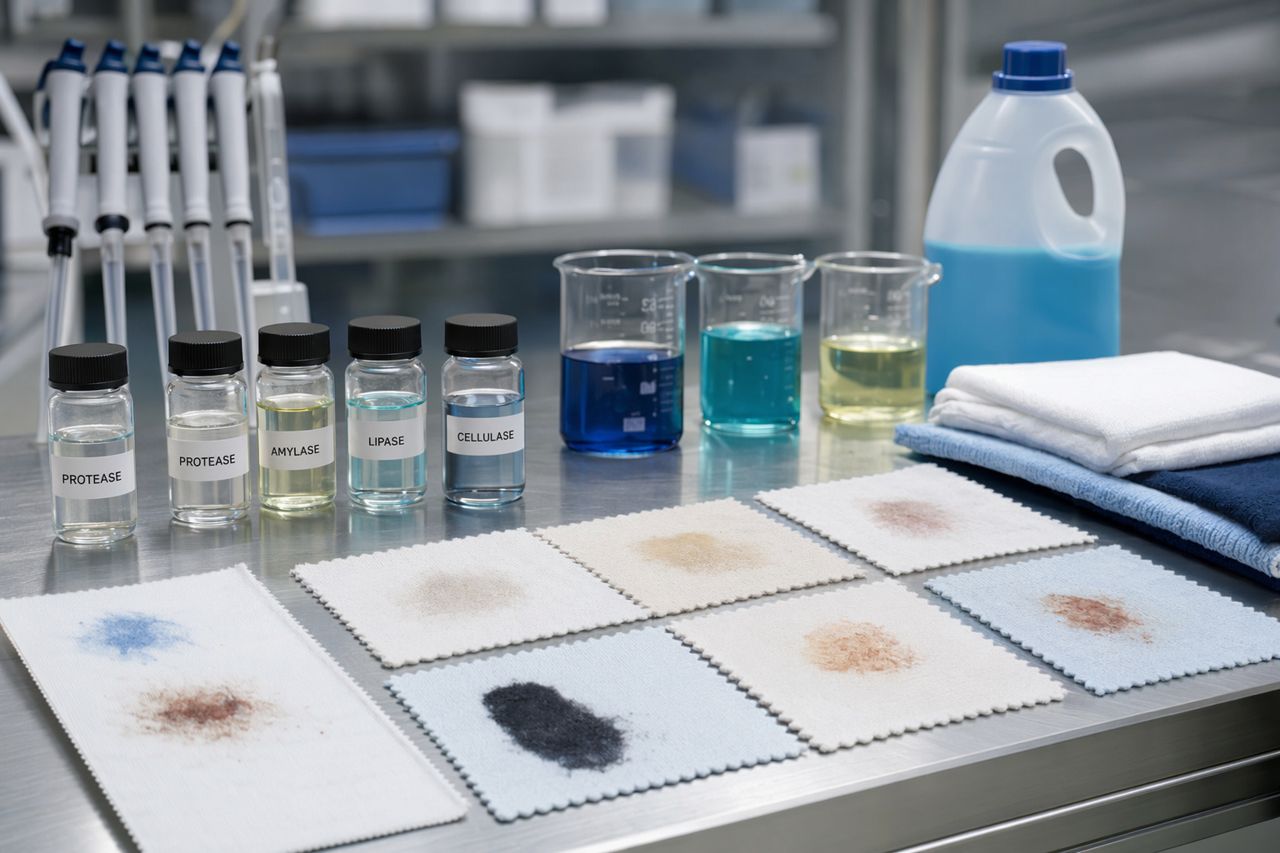
Different enzyme classes solve different formulation problems. A differentiated laundry range usually does not rely on one enzyme type across every SKU. It maps enzyme classes to soils, substrates, wash temperatures, and customer segments.
Protease for protein-rich soils
Protease is commonly selected for protein-based stains such as blood, egg, dairy, grass, sweat, and food residues. For industrial laundry chemical suppliers, protease can support detergents aimed at hospitality linens, healthcare textiles, uniforms, aprons, and food service fabrics.
Key formulation questions include:
- What pH range will the detergent system run in?
- Will the enzyme face high alkalinity, oxidizing conditions, or strong chelation?
- Is the product a liquid, powder, paste, or concentrated additive?
- Will it be used in a main wash, presoak, prespotter, or booster step?
Amylase for starch and carbohydrate soils
Amylase helps break down starch-based residues found in sauces, gravies, baby food, bakery soils, and processed food deposits. It can be especially useful in food service, hospitality, and institutional laundry programs where starch soils contribute to fabric dullness or redeposition.
A private-label brand can use amylase to create a dedicated food-service detergent, table linen additive, or multi-enzyme booster positioned around starch-heavy soil loads.
Lipase for fats, oils, and greasy residues
Lipase is selected for triglyceride-based soils, cooking oils, body oils, sebum, and greasy residues. It is relevant for kitchen uniforms, towels, spa linens, hospitality textiles, and food processing workwear.
When developing lipase-containing products, manufacturers should evaluate surfactant system fit, wash temperature profile, fragrance system compatibility, and expected contact time in the customer’s process.
Cellulase for cotton appearance and fabric surface care
Cellulase can support cotton fabric appearance by helping reduce surface fuzz and particulate retention. In commercial laundry positioning, this can translate into cleaner-looking cottons, improved hand feel, brightness support, and reduced greying tendency over repeated washes.
Cellulase selection should consider textile type, exposure time, pH, temperature, and whether the product is intended for routine maintenance or specialty fabric care.
Multi-enzyme systems for SKU-level positioning
A multi-enzyme detergent or additive can be built around a defined performance target:
- Hospitality linen detergent for body soils, food soils, and brightness maintenance
- Food service uniform detergent for grease, starch, and protein soils
- Healthcare laundry additive for protein-rich soils and mixed organic stains
- Low-temperature wash booster for energy-conscious laundry programs
- Cotton care additive for appearance retention and fabric smoothness
The strongest private-label lines use enzyme combinations intentionally, not as a generic feature claim.
Watch: building differentiated private-label laundry products with enzymes
[Faceless explainer video embed: private-label commercial laundry detergent enzyme strategy]
This short explainer shows how enzyme class selection, wash-condition mapping, and formulation compatibility work together when developing commercial laundry detergents and additives for private-label programs.
Formulation variables that influence enzyme performance
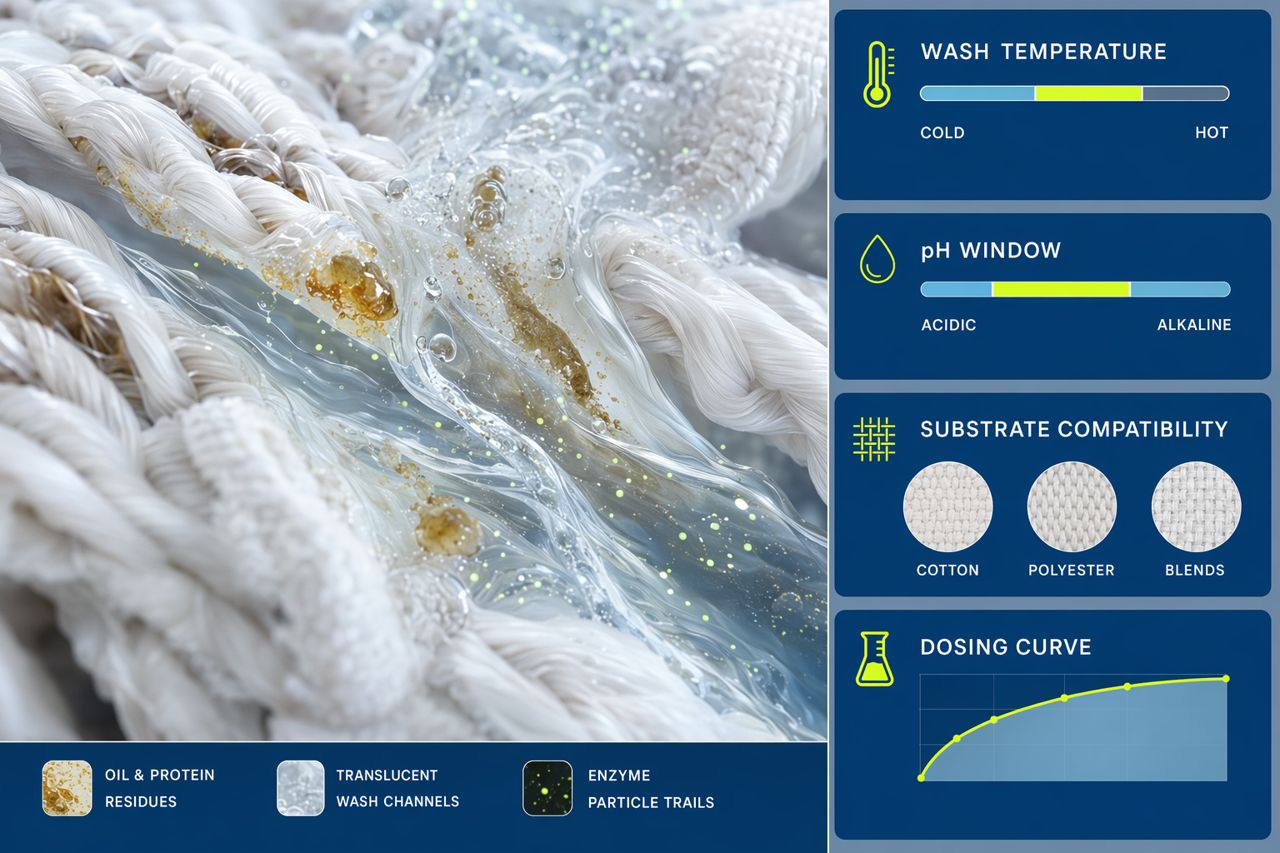
Industrial laundry detergents are complex systems. Enzyme performance depends not only on enzyme class, but also on the chemical environment and how the final product is used by laundry operators.
Wash conditions
Commercial laundries vary by machine type, water hardness, soil loading, cycle length, temperature, and dosing equipment. Enzyme selection should reflect the real-use wash window rather than an idealized lab condition.
Important variables include:
- Main wash temperature range
- Alkalinity and final wash pH
- Water hardness profile
- Contact time and wash mechanics
- Bleach step placement
- Prewash, main wash, and rinse sequence
- Dosing method and dilution behavior
Substrate compatibility
Industrial laundry suppliers serve multiple fabric types, including cotton, polyester-cotton blends, microfiber, towels, sheets, uniforms, napery, mats, and specialty institutional textiles.
A formulation intended for cotton hospitality linens may not require the same enzyme profile as a product for greasy polyester workwear. Substrate compatibility helps determine which enzyme classes are useful, which should be limited, and how the claim should be framed.
Product format
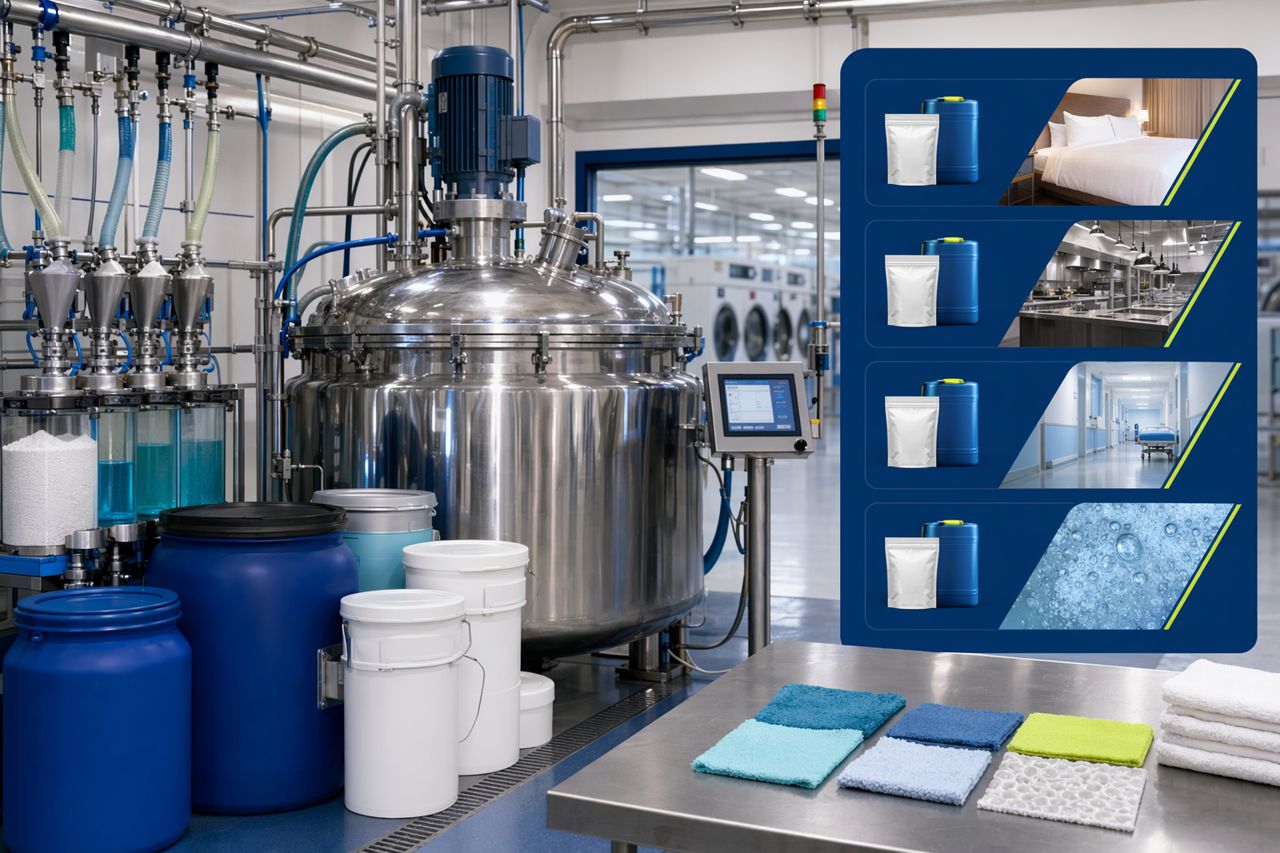
Enzyme strategy changes by format:
- Liquid detergents require attention to enzyme stability in water-rich systems, surfactant blends, preservatives, and pH over storage.
- Powder detergents may use encapsulated or granulated enzyme forms selected for handling, dispersion, and compatibility.
- Concentrated additives need stability under higher active ingredient load and controlled dilution behavior.
- Prespotters and presoaks may need fast contact performance against specific stains before the main wash.
A private-label range can include different enzyme approaches by product type rather than forcing one formula architecture across the entire line.
Commercial benefits for industrial laundry chemical suppliers
Working with the right enzyme supplier can support both technical development and commercial positioning.
Clearer product segmentation
Enzymes allow brands to segment by application:
- General commercial detergent
- Hospitality linen detergent
- Food service grease and starch detergent
- Healthcare and institutional stain additive
- Low-temperature wash booster
- Cotton appearance care additive
- Premium multi-enzyme detergent concentrate
This gives sales teams a practical reason to recommend one SKU over another.
Better value story for private-label customers
Laundry operators are focused on outcomes: fewer rewashes, cleaner textiles, better appearance, less energy pressure, and process reliability. Enzyme-enabled formulations can support those outcomes when selected around the customer’s soil profile and wash process.
For product managers, this can become a stronger value story than simply increasing surfactant or builder load.
Faster development with fewer reformulation loops
A formulation-led enzyme selection process helps reduce guesswork. By sharing product format, target wash pH, temperature range, surfactant system, bleach exposure, and target soils early, a supplier can recommend enzyme classes and formats with a better probability of fit.
That means fewer unnecessary prototypes and a clearer path from lab batch to pilot production.
Scale-up confidence
Private-label detergent programs must perform beyond the bench. Enzyme handling, storage, blending order, packaging, shelf-life expectations, and production process conditions all matter. SoilVector supports development teams with practical enzyme selection and scale-up considerations for commercial laundry chemical manufacturing.
How SoilVector supports private-label laundry detergent development
SoilVector works with industrial laundry chemical suppliers that need enzyme inputs for new product development, private-label expansion, formula renovation, and customer-specific detergent programs.
Support can include:
- Enzyme class selection by soil type and fabric substrate
- Compatibility guidance for liquid, powder, and additive formats
- Input selection for low-temperature and standard wash programs
- Multi-enzyme package planning for differentiated SKU families
- Scale-up considerations for blending, storage, and product handling
- Technical discussion around pH, surfactants, builders, chelants, preservatives, and bleach exposure
- Commercial positioning support for B2B laundry product lines
We do not treat enzymes as generic ingredients. We help match enzyme function to the wash process and the product claim your customers need to understand.
Practical starting brief for a quote request
To speed up recommendation and quoting, include as much of the following as possible in your request:
- Product type: detergent, booster, prespotter, presoak, additive, or concentrate
- Format: liquid, powder, granule, paste, tablet, or unit-dose system
- Target customer segment: hospitality, healthcare, food service, uniform rental, institutional, or on-premise laundry
- Target soils: protein, grease, starch, body soil, particulate soil, or mixed soil
- Fabric types: cotton, polyester-cotton, microfiber, towels, sheets, uniforms, napery, or specialty textiles
- Wash temperature range and typical cycle design
- Approximate wash pH and alkalinity profile
- Surfactant, builder, chelant, preservative, and bleach exposure details
- Packaging and expected storage conditions
- Development stage: concept, reformulation, pilot, or scale-up
Build a private-label laundry line with clearer performance logic
A competitive private-label commercial laundry detergent line is not built on a label alone. It is built on product architecture: which soils each SKU targets, which fabrics it protects, which wash conditions it supports, and how reliably the formulation performs in customer operations.
Enzyme selection can help make that architecture more precise.
If you are developing or improving a private-label laundry detergent, booster, prespotter, or additive, SoilVector can help identify enzyme options aligned with your formulation and commercial goals.
Request a quote through the on-site contact form and share your target product format, wash conditions, and soil profile. A SoilVector specialist will review the brief and respond with practical next steps.