Laundry Detergent Enzyme Blend Guide for Chemical Manufacturers
Industrial laundry detergents need to remove mixed soils across varied textiles, wash programs, water quality, and dosing habits. For chemical manufacturers, enzyme selection is not only a stain-removal decision. It affects product positioning, compatibility with builders and surfactants, storage stability, cost-in-use, and the confidence needed to scale from pilot batches to recurring customer supply.
SoilVector supplies enzyme ingredients for manufacturers building industrial laundry powders, liquids, concentrates, presoaks, boosters, and spot-treatment additives. This guide explains how protease, lipase, amylase, and cellulase contribute to finished laundry chemical performance and how to structure an enzyme blend around real wash conditions.
Looking for an enzyme supplier for industrial laundry chemicals? Use this page to define your blend requirements, then request a quote for individual bulk enzymes or a supply discussion matched to your formulation route.
Why enzyme blends matter in industrial laundry chemistry
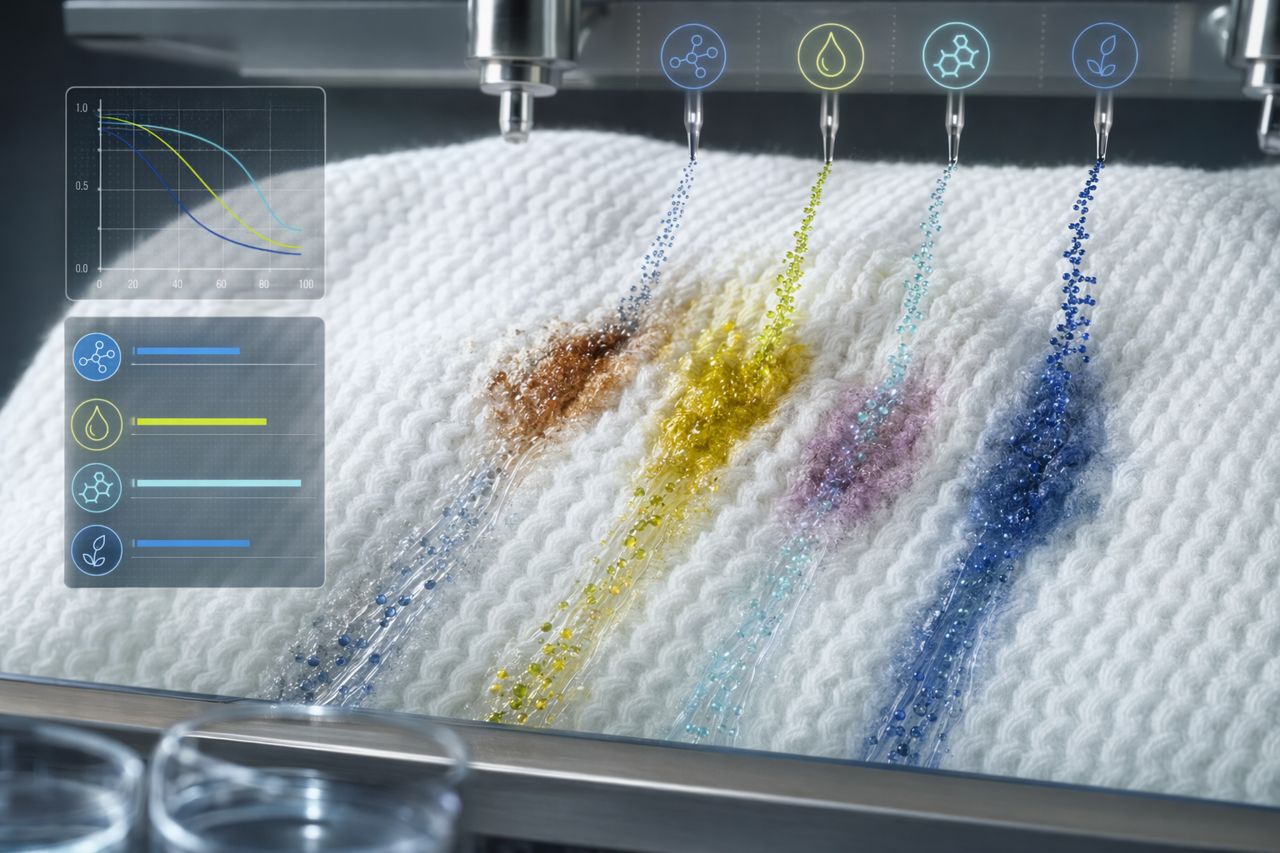
Industrial laundry soils are rarely single-component. A hospitality towel may carry body soils, food grease, starch-based residues, cosmetics, and particulate soil in the same load. Workwear may combine proteinaceous soil, oils, outdoor dirt, and repeated fabric wear. A single enzyme class can improve one soil type, but a deliberate blend can widen the finished product claim without forcing harsher wash conditions.
For product managers, the commercial value is clear:
- Broader stain coverage across food service, hospitality, healthcare-adjacent, uniform, and facility laundry segments
- Better low-temperature wash support where energy reduction is part of the customer value proposition
- Differentiated detergent, booster, presoak, and spotter formats
- More consistent performance on cotton, poly-cotton, microfiber, and blended textiles
- Formulation flexibility alongside surfactants, alkalinity systems, sequestrants, oxygen bleach systems, and anti-redeposition polymers
- Clearer purchasing routes by enzyme class instead of relying on generic additive claims
The four core enzyme classes for laundry detergent development
Protease: protein soil removal and broad baseline performance
Protease is commonly the foundation enzyme in industrial laundry detergents because protein-containing soils are frequent and visually persistent. Typical targets include blood-derived residues, sweat, collar soil, food protein, dairy residue, egg, and other organic matter that can bind strongly to textile fibers.
In finished laundry products, protease can support:
- Cleaner results on body soil and food-service textiles
- Improved stain release in alkaline detergent systems
- Stronger performance in lower-temperature wash programs
- Reduced reliance on aggressive chemistry for protein-based stains
- A more robust base claim for institutional and commercial detergent lines
Formulation teams should evaluate protease compatibility with surfactant packages, builders, alkalinity, chelants, preservatives, fragrance systems, and bleach strategy. For liquid products, storage stability and enzyme protection are central to successful scale-up.
Best-fit product formats: industrial laundry detergents, protein stain boosters, presoak additives, hospitality detergent systems, uniform care products.
Next sourcing step: review bulk protease options for alkaline laundry formulations and liquid or powder format needs.
Lipase: grease, body oils, and fatty soil release
Lipase targets triglyceride-based soils and fatty residues that are difficult to remove through detergency alone, especially in lower-temperature programs. It is useful when the finished product must address food grease, kitchen textiles, sebum, cosmetics, and oily residues on uniforms and towels.
In a laundry enzyme blend, lipase can help manufacturers build claims around:
- Grease and oil stain removal
- Better cleaning on food-service linens and kitchen workwear
- Improved release of body oils from towels, sheets, and garments
- Performance support where wash temperature is constrained
- Differentiation in hospitality, restaurant, and facility service detergents
Lipase selection should be checked against nonionic surfactants, solvents, hydrotropes, and fragrance components. For products targeting oily soils, the enzyme is only one part of the system; surfactant architecture and soil suspension chemistry remain critical.
Best-fit product formats: grease-focused boosters, food-service laundry detergents, hospitality towel detergents, oily workwear detergents, concentrated liquid additives.
Next sourcing step: compare bulk lipase options for grease-heavy laundry segments and compatible formulation formats.
Amylase: starch and carbohydrate soil removal
Amylase breaks down starch-based residues commonly found in food-service and hospitality laundry. These soils can act as binders for other particles, making fabrics look dull or incompletely cleaned even when other stains are addressed.
Amylase is especially relevant for products sold into:
- Restaurant and catering linen programs
- Hotel napkins, tablecloths, and kitchen textiles
- Food-processing uniforms
- Laundry boosters for starch-thickened sauces, gravies, cereals, and prepared foods
In blended systems, amylase can improve removal of starch soils and help prevent starch residues from holding particulate soil on fabric. It can also strengthen product positioning where food-service performance is a core purchase driver.
Formulators should evaluate amylase alongside alkalinity, sequestration, bleach systems, and wash liquor conditions. It is often used as part of a multi-enzyme approach rather than as a stand-alone detergent performance driver.
Best-fit product formats: food-service laundry detergents, linen care boosters, presoak additives, commercial table-linen wash systems.
Next sourcing step: source bulk amylase for starch-targeted detergent and additive lines.
Cellulase: fabric appearance, brightness, and fiber-surface care
Cellulase acts on cellulose fiber surfaces and is used differently from stain-targeting enzymes. In laundry applications, its value is tied to fabric appearance, brightness, pilling control, and removal of microfibrils that trap soil and dullness on cotton-rich textiles.
Cellulase can support claims related to:
- Fabric brightness maintenance on cotton and cotton-rich blends
- Reduced dullness from repeated wash cycles
- Improved surface cleanliness and hand feel
- Enhanced appearance in hospitality textiles and uniforms
- Support for premium detergent positioning beyond basic stain removal
Because cellulase interacts with cellulose-containing textiles, dose strategy and application fit matter. It should be selected with attention to textile mix, wash duration, alkalinity, mechanical action, and the intended claim. It is not the right tool for every laundry line, but it can be highly valuable where fabric renewal and long-term appearance are part of the customer promise.
Best-fit product formats: premium hospitality detergents, cotton-focused laundry additives, brightness maintenance detergents, textile-refresh products.
Next sourcing step: evaluate bulk cellulase options for fabric appearance and cotton-surface performance.
Building the enzyme blend around the finished product claim
A strong enzyme blend starts with the product brief, not the ingredient list. Before selecting enzymes, define the wash conditions and commercial claim the detergent must deliver.
1. Identify the target laundry segment
Different customers generate different soil profiles.
- Hospitality: body oils, cosmetics, food soils, towel greying, repeated wash cycles
- Food service: grease, starch, protein, sauces, table linen staining
- Uniform and workwear: oils, sweat, outdoor soil, particulate residue, repeated wear
- Facility services: mixed soils, inconsistent sorting, variable water quality
- Healthcare-adjacent linen processing: proteinaceous soils and strict process expectations, subject to the customer’s compliance framework
Segment clarity prevents overbuilding the enzyme system and helps align cost with customer-visible performance.
2. Match enzyme classes to soil families
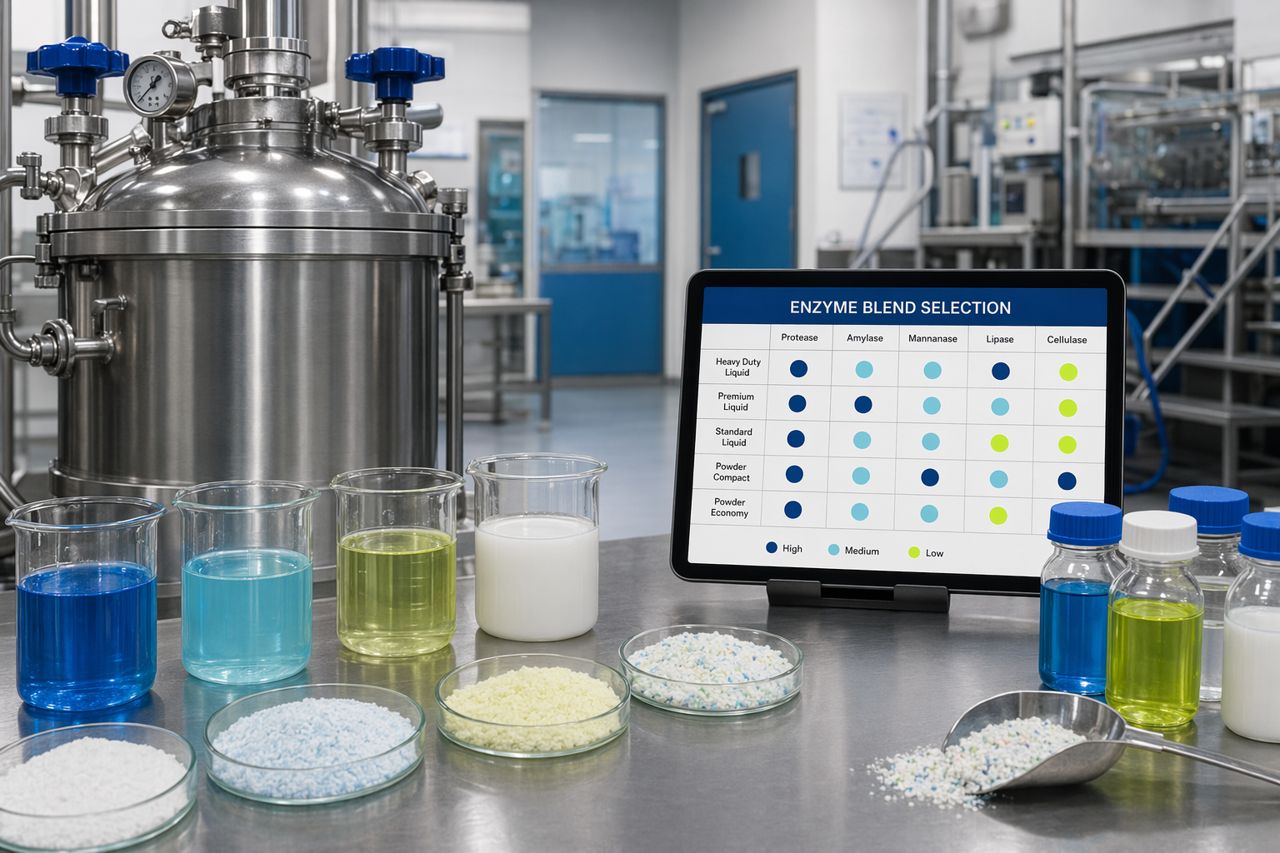
A practical blend map may look like this:
| Soil or performance need | Enzyme class to evaluate | Formulation intent |
|---|---|---|
| Blood-derived, sweat, dairy, egg, food protein | Protease | Core stain removal and broad cleaning support |
| Grease, sebum, kitchen oil, cosmetics | Lipase | Fatty soil release and low-temperature support |
| Starch, sauces, gravies, prepared food residues | Amylase | Food-service linen and carbohydrate soil removal |
| Cotton dullness, pilling, microfibril-bound soil | Cellulase | Fabric appearance and brightness maintenance |
The strongest commercial formulations often combine a core protease with one or more targeted enzymes based on the intended market.
3. Consider powder versus liquid format early
Enzymes behave differently in powders, liquids, concentrates, and multi-part systems.
Powder detergent considerations:
- Granule handling and dust-control expectations
- Compatibility with builders, carbonate systems, oxygen bleach components, and moisture exposure
- Segregation risk during blending and packaging
- Stability through transport and warehouse conditions
Liquid detergent considerations:
- Enzyme stabilization strategy
- Water activity management
- Compatibility with surfactants, solvents, preservatives, dyes, and fragrance
- Viscosity, clarity, and phase stability
- Packaging and shelf-life expectations
SoilVector can support enzyme selection discussions for both routes, including when a multi-component system is more practical than forcing all actives into one bottle.
4. Validate compatibility with the full detergent matrix
Enzyme performance depends on the finished chemistry around it. Product managers should evaluate compatibility with:
- Anionic, nonionic, amphoteric, and specialty surfactants
- Alkalinity and builder systems
- Chelants and water-conditioning agents
- Anti-redeposition and soil-suspension polymers
- Oxygen bleach strategy and bleach activators where used
- Preservatives, fragrance, colorants, hydrotropes, and solvents
- Processing temperature, mixing order, and hold times
- Packaging, storage, and distribution conditions
The goal is not only initial cleaning performance. The goal is a formulation that remains commercially reliable from production batch to customer use.
Common enzyme blend routes for industrial laundry products
Broad-spectrum industrial detergent
A broad detergent usually starts with protease and adds lipase or amylase depending on the target customer base. This route is appropriate for suppliers serving varied accounts and wanting reliable performance across everyday mixed soils.
Typical enzyme direction: protease-led blend with optional lipase and amylase.
Food-service linen detergent or booster
Food-service applications benefit from targeting grease, protein, and starch together. A detergent positioned for restaurants, catering, and kitchen textiles should usually evaluate protease, lipase, and amylase as a coordinated system.
Typical enzyme direction: protease plus lipase plus amylase.
Hospitality towel and sheet program
Hospitality laundries often need body soil removal, fabric brightness, towel freshness, and long-term textile appearance. Protease and lipase can address organic and oily residues, while cellulase may support premium appearance claims for cotton-rich textiles.
Typical enzyme direction: protease plus lipase, with cellulase for appearance-led positioning.
Uniform and workwear detergent
Uniform programs can carry sweat, oils, outdoor particles, and repeated fiber wear. Protease and lipase are commonly relevant, while cellulase may be considered where cotton-rich fabric appearance matters.
Typical enzyme direction: protease plus lipase; evaluate cellulase by textile type.
Presoak or stain-treatment additive
Presoaks and boosters can carry more targeted claims than a main detergent. This is where a manufacturer may build an enzyme additive around protein stains, grease-heavy loads, or food-service residues.
Typical enzyme direction: select one to three enzymes based on the claim and use instructions.
Purchasing considerations for bulk laundry enzymes
When sourcing enzymes for industrial laundry chemical manufacturing, request practical supply information that supports formulation and procurement decisions.
Useful specification and commercial inputs include:
- Enzyme class and application fit
- Recommended product format compatibility
- Physical form and handling requirements
- Expected stability considerations in powder or liquid systems
- Compatibility guidance for common detergent components
- Packaging options for pilot, validation, and production purchasing
- Lead time, batch consistency, documentation, and supply continuity
- Technical support during formulation screening and scale-up
Avoid choosing on headline strength alone. The best enzyme for your detergent is the one that fits the finished matrix, storage environment, wash conditions, customer segment, and margin target.
Scale-up confidence: from bench screen to commercial line
A practical enzyme program should move through staged validation:
- Define the soil profile and product claim. Establish target textiles, wash conditions, and customer value.
- Screen enzyme classes individually. Identify which enzymes create visible and measurable formulation value.
- Build blend candidates. Combine enzymes only where each class supports the claim.
- Check formulation compatibility. Evaluate the full detergent matrix, not enzymes in isolation.
- Run storage and handling checks. Confirm performance after realistic production, packaging, and warehouse exposure.
- Validate cost-in-use. Balance ingredient cost with wash outcome, customer segment, and market positioning.
- Prepare purchasing scale-up. Align pack size, lead time, documentation, and quality expectations before launch.
This approach reduces reformulation risk and helps product managers justify enzyme choices to commercial, procurement, and technical stakeholders.
Work with SoilVector on laundry enzyme sourcing
SoilVector supplies bulk enzyme ingredients for industrial laundry chemical manufacturers developing differentiated detergents and additives. Whether you are building a protease-led base detergent, a grease-focused booster, a food-service linen system, or a fabric-brightness product, we can help align enzyme class selection with your formulation route and purchasing requirements.
Use the quote form to share your target product format, soil profile, textile segment, and expected purchase scale. We will respond with relevant enzyme options and practical next steps.
Request a quote
Ready to source enzymes for an industrial laundry detergent or additive line?
Request a quote using the on-site form
Include, where available:
- Product type: powder, liquid, concentrate, presoak, booster, or spotter
- Target customer segment: hospitality, food service, uniform, facility laundry, or other
- Enzyme classes of interest: protease, lipase, amylase, cellulase, or blend discussion
- Key soils and fabric types
- Compatibility concerns in your current formula
- Pilot or production purchasing timeline